








You’ve got a new solar battery to power your home through the night. It’s a great start. But you’re now at a crossroads.
What coupling should you choose between AC vs DC coupling?
It may seem like choosing between the two won’t make a difference. However, that’s not true.
The solar battery connection method affects your system’s energy efficiency, design, and even the overall return on investment (ROI).
And yes, this is the case even if you’ve chosen the perfect battery for your setup.
Let’s understand this in detail so you can pick the right coupling method for your solar system.
How Do You Connect a Solar Panel to a Battery? (Simple Explanation)
Solar batteries don’t always work as plug-and-play. The reason is that solar panels generate DC (Direct Current) electricity, while household appliances primarily run on AC (Alternating Current) electricity.
To make them usable, they must be used with inverters or MPPT (Maximum Power Point Tracking) controllers.
So, what exactly is AC vs. DC coupling?
- AC coupling: The solar battery is a part of your home’s electrical system.
- DC coupling: This is a direct battery connection to your solar panels.
The right setup for you depends on whether you’re installing a new solar system or upgrading an existing one with solar batteries.
It’s important to note that both AC and DC coupling can be used for off-grid and grid-connected setups.
What is DC Coupling? (Direct Connection Explained)
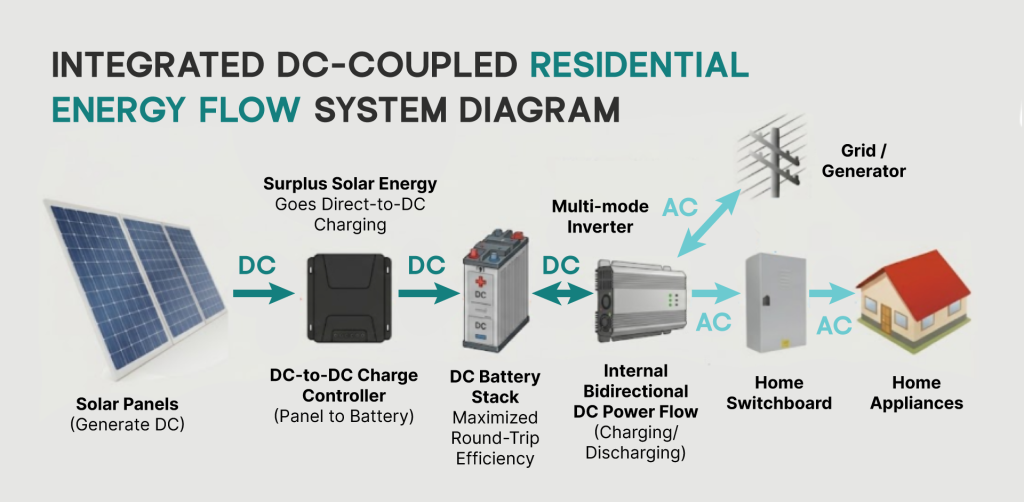
As mentioned above, DC coupling is a direct connection of the battery to the solar panels. It involves a charge controller that converts panel voltage to battery voltage at high efficiency.
Both solar panels and batteries operate on DC electricity, so they don’t need an inverter between them.
This setup reduces the number of energy conversions. As a result, the overall power loss is quite low. However, it’s typically used only in new installations as it requires an integrated all-in-one design.
Also, the hybrid inverter used in these setups is shared between solar panels, batteries, and the grid, so installing it from scratch is cleaner and cheaper. The overall setup is simpler than AC coupling.
What is AC Coupling? (Flexible Retrofit Solution)
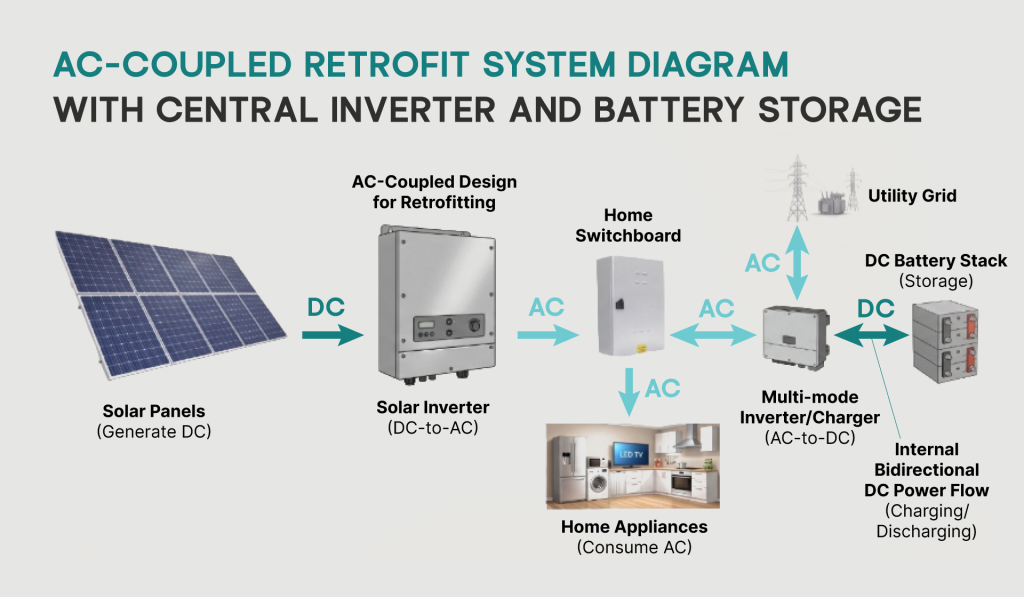
In this case, the battery isn’t connected to the solar panels, but to your home. As a result, solar energy undergoes multiple conversions before reaching the battery.
Unlike DC coupling, this method involves two inverters. One for converting DC to AC electricity (solar to home) and the other for converting AC electricity back to DC (home to battery).
This system is much longer as you have to convert power multiple times to charge your solar battery, which reduces efficiency. However, the key advantage here is that you can retrofit your battery into existing solar systems using AC coupling. This flexibility isn’t available in DC coupling.
Efficiency Comparison: Which System Loses Less Energy?
DC-coupled systems are usually more efficient than AC-coupled ones. Let’s compare their efficiency in detail:
DC-Coupled Systems
DC electricity generated by the solar panels passes through the MPPT charge controller and goes directly into the battery as DC electricity. As a result, the energy loss is reduced, and the efficiency can be as high as 99%.
The setup is also usually cheaper as you only need a single inverter and fewer additional equipment.
AC-Coupled Systems
Unlike DC-coupled systems, energy is converted multiple times (DC to AC and back again) before it reaches the battery. The increased number of conversions results in lower efficiency compared to DC-coupled systems, with efficiency ranging between 90-95%.
The costs involved are also on the higher end, as two inverters are needed along with several other components.
And while the efficiency difference may seem low, it could add up over time, especially if your energy usage is high.
Compatibility: New Installations vs. Retrofitting Existing Systems
When it comes to compatibility, each system fares differently due to the different types of components required.
DC-Coupled Systems
DC coupling is best suited for new installations, as the hybrid inverter is shared between the battery and the solar panels. The power is only converted to AC electricity when you actually use it.
The higher efficiency makes it the ideal way forward.
However, it’s not a good idea if you’re looking to retrofit your existing systems. That’s because you’d have to replace your existing inverters with the new hybrid inverter, which would increase your system costs and dramatically reduce your ROI.
You’d also incur significant labour costs to modify the existing wiring. Lastly, the flexibility is less as hybrid inverters should match your panel and battery brands.
AC-Coupled Systems
If you already have a solar panel setup in your house, AC coupling is the way to go. Instead of having to replace your inverter, you’ll only need to add a second battery inverter with your solar battery.
This essentially becomes a plug-and-play solution for existing setups. You also get greater flexibility in terms of the brand and age of the original inverter. It’s also possible to attach the battery to your switchboard while keeping the existing setup intact, which reduces your labour costs.
Choosing the Right Option for Your Home
While DC coupling offers superior efficiency, it offers limited flexibility. On the contrary, AC coupling provides greater flexibility for a slightly lower efficiency.
So which option is best for you? Let’s understand.
System and Inverter Age
If you don’t have an existing system, DC is the best option. However, if you already have an existing setup, AC is a better idea.
Moreover, solar inverters usually have a life of 10-15 years. It only makes sense to retrofit with DC coupling if your inverter is nearing the end of its life. Otherwise, AC coupling is the way ahead.
Future Goals and Scalability
If you’re planning to scale your solar setup in the future to meet higher energy needs (e.g., high-energy appliances) or to generate more revenue through VPPs, AC coupling is better.
It’s possible to stack AC-coupled batteries as they work as independent units. You don’t have to worry about the solar inverter’s capacity.
On the other hand, a hybrid inverter has a maximum power rating. If you add more panels or a larger battery later, you’ll hit a ceiling on what the inverter can handle.
Installation Costs and ROI
For new installations, DC coupling costs are reasonable, because you only need to buy one inverter. But if you already have an existing setup, it’s much more expensive than AC coupling.
In the long run, DC coupling provides a higher ROI owing to the higher efficiency, which reduces your power costs. You also have more electricity to sell to VPPs.
However, with existing setups, AC coupling tends to deliver a better ROI unless you have an old solar inverter.
In either case, it makes sense to consult with solar experts to audit your existing setup and ensure that it aligns with current and future needs and delivers a superior ROI.
The Right Setup Depends on Your System
If you’re planning to buy a solar battery, there’s no one-size-fits-all answer. The right coupling method depends on your current situation, as each offers distinct advantages.
Ultimately, understanding the differences between AC and DC coupling can help you choose the right option for your unique needs.
An expert like Think Renewable can help here.
We can design a customised solar and battery solution that’s completely tailored to your home, whether you’re installing a new system or upgrading an existing one.