
If you’ve got a pool pump, oven, or spa, your electricity meter could be running as fast as the reels of a slot machine.
The result, as you might have guessed, is skyrocketing energy bills.
But by powering them with solar panels, you can dramatically reduce their impact on your bills during the day. And with a solar battery, it’s possible to power your home through the night too.
However, it comes with a caveat.
No two appliances consume energy equally. If your energy use is much higher than the battery’s capacity, it likely won’t help.
And that’s why it’s critical to choose the right battery for your unique power needs.
Understanding Appliance Energy Consumption in Australian Homes
Every appliance or electronic gadget uses energy in kilowatts (kW). And their hourly electricity usage is measured in kilowatt-hours (kWh), which equals a single unit of electricity.
For instance, if a device has a power rating of 2kW and runs for 6 hours, it’ll consume 12kWh of electricity.
To identify the right battery size for your home, it’s important to find out your overall power consumption during the overnight period.
Here’s the typical energy consumption of common appliances so you can calculate how much energy you use every night:
| Appliance | Power Rating (Watts) | Typical Use (Evening/Overnight) | Total Energy (kWh) |
| Spa (Heating) | 2 – 6kW | 3 – 5 hours (Maintaining heat) | 6.0 – 30.0 kWh |
| Ducted Air Con | 5 – 6kW | 4 hours (Evening) | 20.0 – 24.0 kWh |
| Electric Oven | 2 – 3kW | 1 hour (Cooking dinner) | 2.0 – 3.0 kWh |
| Pool Pump | 1 – 1.5kW | 8 hours (Overnight) | 8.0 – 12.0 kWh |
| Iron | 1 – 2kW | 30 mins (Quick press) | 0.5 – 1.0 kWh |
| Ceiling Fan (AC Motor) | 15 – 90W | 8 hours (Overnight) | 0.1 – 0.7 kWh |
| LED Lights (per bulb) | 8 – 12W | 5 hours (Evening) | 0.04 – 0.06 kWh |
| Halogen Downlight | 50W | 5 hours (Evening) | 0.25 kWh |
| Laptop / PC | 40 – 200W | 4 hours (Evening) | 0.16 – 0.8 kWh |
| Dishwasher | 1.2 – 1.5kW | 1.5 hours (1 cycle) | 1.8 – 2.2 kWh |
| Electric Kettle | 2.2 – 2.4kW | 10 mins (4-5 boils) | 0.4 kWh |
| 65″ LED TV | 100 – 150W | 4 hours (Evening) | 0.4 – 0.6 kWh |
| Fridge/Freezer | 100 – 200W | 12 hours (Evening/Night) | 1.2 – 2.4 kWh |
How to Estimate the Battery Size You Need for Overnight Usage
The average Australian home has a nominal installed battery size of 19 kWh, with the Northern Territory leading at 24.8 kWh.
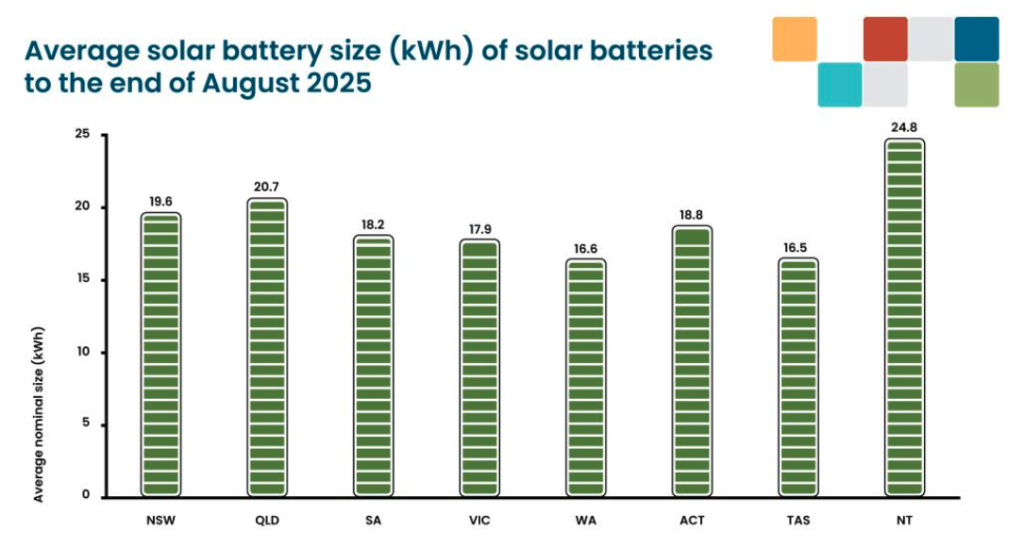
Image via Clean Energy Regulator
Should you go for a similarly sized battery? Well, it depends.
To find the right battery size for your home, use the table above to calculate your total overnight power demand.
For each appliance, multiply the kWh consumption by the usage duration, then sum them all up. The figure you get is your total energy use.
Here’s an example for a house that uses a fan, light, TV, and refrigerator for the evening and night.
- Fan: 0.09 kWh x 8 = 0.7 units
- Fridge: 0.2 kWh x 12 = 2.4 units
- Light: 0.012 kWh x 5 = 0.06 units
- TV: 0.15 kWh x 4 = 0.6 units
The total energy use comes to 3.76 kWh in this case.
Similarly, you can calculate your total power demand to find out the right battery size for your house. Once you’ve got a number, choose a battery that’s at least 10-20% larger than it.
And why is that?
It’s because there’s a difference between a battery’s total size and its usable capacity. Most batteries come with a 5-10% reserve charge to prevent them from reaching absolute 0% charge, as that can render the unit inoperable.
Additionally, no battery is 100% efficient. It tends to lose energy due to heat production and environmental factors. In the hotter Australian climates, these losses can be higher.
In a nutshell, you’d be able to use about 90-95% of a battery’s rated capacity. So, if your overnight power consumption is 9kWh, you need a battery with at least 10kWh capacity.
You should also account for the battery wear and tear over the years, as they’re long-term investments.
The average Lithium-based solar battery loses about 1-3% of its capacity each year. Opting for a slightly larger battery than your current energy use helps you make up for this capacity loss and leaves some scope for increased future energy demands.
Managing High-Draw Appliances Like Ovens, Air Conditioners, and Spas
Appliances like ovens, spas, and air conditioners are considered high-draw appliances due to their high power consumption. Running these for extended periods can rapidly drain your solar battery storage.
For instance, if you run a 2.5kW air conditioner for just 5-8 hours, it’ll drain out a 10kWh battery. A larger 15-20kWh battery can last all night while powering your air conditioner. But if you add a pool pump, spa, and ovens into the mix, even a 20kWh battery will seem tiny.
According to the figures in the table above, the total consumption of a spa, air conditioner, pool pump, and oven would range from 22 to 69kWh. Clearly, a 20kWh battery wouldn’t suffice.
So, if you’ve got these appliances, it makes sense to power them more during the day, when solar panels are actively producing energy. This way, your battery can last through the night by powering fixtures and electronics that consume less power.
When you use them during the day, you improve the battery ROI as these appliances use the surplus power generated by the panels. You essentially power your home for free during the day and keep your battery “full” for evening essentials.
Combining Solar Production and Battery Storage for Better Results
Solar panels and battery storage work in tandem to help power your home through the day and night.
During the day, your solar panels take the lead, directly powering heavy appliances like the pool pump, oven, and spa.
This “solar-first” approach means these energy-intensive tasks are finished for free before the sun sets.
And even if your power demand exceeds solar production, you can draw cheap energy from the grid.
This way, your battery capacity remains intact for evening peak and overnight use. It ensures that you don’t have to spend on expensive evening electricity from the grid.
In fact, you can even sell some of your excess energy through Virtual Power Plants to generate a passive income and increase your solar ROI.
These VPPs pay you a fee for each unit of energy they take from your battery. Selling your power to them during peak demand can help you generate a steady income stream while also meeting your domestic power needs.
Optimise Your Solar Battery Usage
Understanding how heavy appliances use energy helps you make smarter battery-sizing decisions.
While a solar battery is completely capable of powering your home through the night, it makes sense to restrict heavy appliance use to daylight hours when solar panels generate excess energy.
But this is just the tip of the iceberg. The right solar battery size depends on various factors like your solar panel setup capacity, energy usage patterns, appliances, environment, and so on.
At Think Renewable, we live and breathe solar and can help you choose the right solar battery for your home.
Get in touch with our team of experts now for a personalised solar battery assessment.
Note: The Cheaper Home Battery Rebate is set to reduce significantly from May 1st, so you might want to move fast.