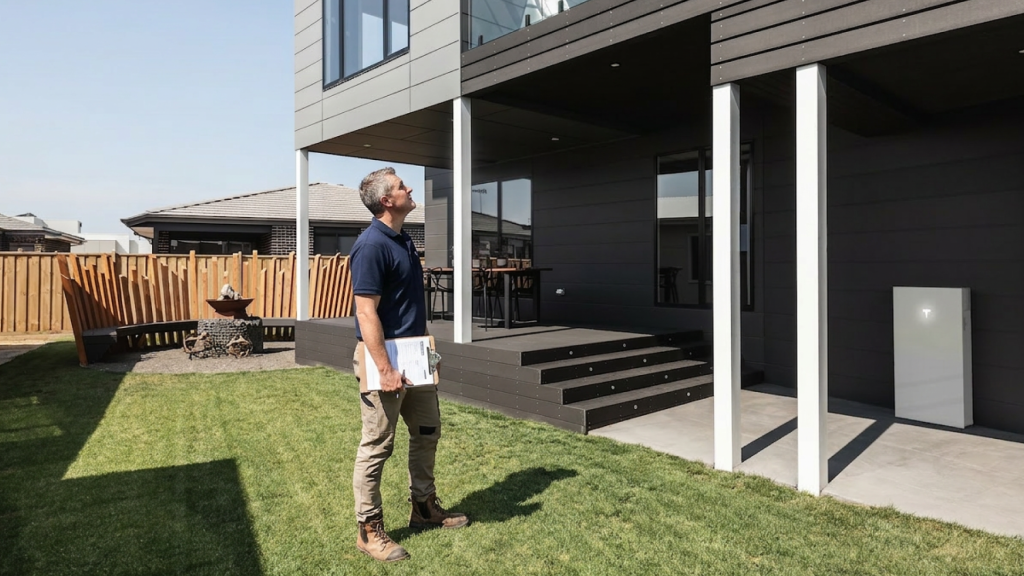

The Clean Energy Council’s latest Rooftop Solar and Storage Report reveals that home battery installations reached record-breaking levels in the second half of 2025. The total installed capacity has climbed up to 28.3 GW.
The surge signals a shift in how Australian households use energy.
With volatile electricity prices, concerns about grid reliability, and a growing desire for energy independence, traditional energy sources no longer fit the bill.
Batteries, on the other hand, let homeowners store solar power, gain control over electricity bills, and reduce their dependence on the grid.
Let’s take a closer look at CEC’s report and understand what it means for homeowners.
Record-breaking growth in home battery installations
More than 183,000 home solar battery systems were sold in the second half of 2025 alone, a fourfold increase compared to the same period in 2024. That’s also more than the combined sales between 2020 and 2024.
These figures show just how quickly batteries have moved from an emerging technology to a standard household investment.
They also shed light on how Australians are using rooftop solar.
Early adopters focused on generating power during daylight hours to offset electricity costs.
But today, households are increasingly pairing solar panels with battery storage to capture excess energy rather than exporting it to the grid.
They can use the stored power in the evenings when electricity prices are typically at their highest. For homeowners, that means greater self-consumption, lower electricity bills, and less exposure to peak pricing.
Government incentives are driving demand for home batteries
In July 2025, the Federal Government launched the Cheaper Home Batteries Program. It expanded the Small-scale Renewable Energy Scheme to include battery storage, delivering an estimated upfront discount of 30% on eligible systems.
The policy shift reduced the cost barrier that had previously held many households back, and its impact was immediate.
State-based programs have further amplified this effect. Initiatives, such as Western Australia’s Residential Battery Scheme and the Victorian Energy Upgrades program, allow eligible households to stack rebates and, in some cases, access low- or no-interest loans.
When combined with federal support, these programs can reduce upfront costs by several thousand dollars. That, in turn, makes battery storage a realistic and attractive option for a wider section of Australian homeowners.
Rooftop solar remains central to Australia’s clean energy shift
Rooftop PV installations in 2025 reached 254,664 units, adding 2.6 GW of newly installed capacity to the grid.
With this, the total installed capacity of solar PVs has exceeded that of Australia’s entire fleet of coal-fired power stations.
In the last six months of 2025 alone, rooftop solar contributed 14.2% of electricity generated in the country, up from 7.2% in 2020.
These numbers emphasise how significant household solar has become within the national energy mix. The widespread solar adoption is also strengthening the case for battery storage.
With increasing solar capacity, households are generating more electricity than they can use during the day, particularly mid-afternoon when solar output is highest.
Batteries help store surplus solar power for use at night or for selling during peak pricing periods, helping households maximise the value of their solar investment.
More battery options and safer products for homeowners
As demand for home batteries has surged, so has the range of products available to Australian homeowners.
The CEC reports that hundreds of new battery models were approved in 2025, taking the total number of accredited solar, inverter, and storage products to over 6,400 nationwide.
In other words, consumers now have more choices than ever when selecting a battery system.
But with greater choice comes the need for strong safety and quality standards.
Battery systems store significant amounts of energy, making product accreditation essential for household safety and long-term reliability.
The good thing is that only batteries meeting strict Australian and international standards are eligible for government incentive programs. It ensures that systems operate safely and perform as expected over their lifespan.
Moreover, accredited installers (like Think Renewable) follow best-practice design and installation standards, reducing the risk of faults, poor performance, or safety issues.
For environmentally conscious households, choosing approved products and accredited installers is non-negotiable when it comes to protecting your home, maximising your investment, and ensuring reliable performance in the long run.
Why now is the right time to consider a home battery
Rooftop solar and home battery systems are no longer a future upgrade. They’ve already become a practical, accessible solution for homeowners who want more control over their electricity use and bills.
If you’ve already installed solar panels, adding a battery can help lower power bills, increase self-consumption, and reduce exposure to rising energy prices.
And if you’re planning to go the solar route, integrating battery storage from the onset helps future-proof your home as energy pricing and grid conditions evolve.
With the cheaper home battery rebate reducing from May 1st, today is the right time to incorporate solar batteries into your energy goals and save on the installation costs.
If you’re ready to explore your options, contact us today to learn more about our residential solar services.